
Introduction
Gambling can look exciting from the outside.
There is speed.
There is hope.
There is the feeling that everything might change in one moment.
Win once, and it can feel thrilling.
Lose once, and it can feel possible to win it back.
That is part of why gambling can pull people in so strongly.
But gambling is not only about money.
It is also about desire.
It touches the human wish to be free, to have more, to worry less, and to escape the limits of ordinary life.
That is why this subject matters.
Gambling may begin as entertainment for some people, but for others it can slowly take more than it gives.
Not only money, but time.
Not only time, but peace.
Not only peace, but trust.
If you want to think more deeply about why human beings are drawn to money and wealth in the first place, you may also enjoy this article on why humans seek wealth.
In this article, we will look at what gambling is, why people are attracted to it, what it seems to offer, and what it may quietly take away.
The Theme: What Gambling Really Is
Gambling
At its simplest, gambling means putting money or something of value at risk in the hope of gaining more.
That may sound simple, but the feeling behind it is not always simple.
A person may gamble because they want excitement.
A person may gamble because they want money.
A person may gamble because they feel stuck and want a fast way out.
In many cases, gambling is not only about the game itself.
It is about what the game seems to promise.
More money.
More freedom.
More possibility.
A different life.
That is why gambling can feel larger than it looks.
It is often connected to hope, fear, greed, frustration, loneliness, and desire all at once.
What Gambling Means in Real Life
In simple words, gambling may mean this:
trying to gain something valuable while risking something valuable.
That is what makes it both attractive and dangerous.
A person may gain money for a moment.
A person may feel pleasure, excitement, or relief.
For a short time, gambling may feel like a door opening.
But that same door can close just as quickly.
Because what is gained can disappear.
And what is lost is not always easy to recover.
Money can be lost.
Time can be lost.
Trust can be lost.
And sometimes a person can lose the feeling of being in control.
That is part of what makes gambling different from ordinary spending or ordinary fun.
The risk is not only financial.
It can slowly become emotional and personal as well.
Why People Are Drawn to Gambling
People are often drawn to gambling because it speaks to a very human wish:
the wish to have more freedom.
Money can feel like freedom.
With money, a person may imagine less stress, more choices, more comfort, and less waiting.
That wish is understandable.
Many people do not dream of wealth only because they are greedy.
Sometimes they are tired.
Sometimes they are afraid.
Sometimes they simply want an easier life.
That is why gambling can be tempting.
It can seem like a shortcut to relief.
For younger people, gambling may look like a fast answer in a world where money feels hard to earn.
For older readers, it may be easier to see that fast money often carries a hidden price.
If you want to reflect on what real value means beyond money alone, you may also enjoy this article on becoming a person of value.
Perhaps the deeper question is not only, “How can I get more?”
Perhaps it is also, “What kind of life am I trying to build?”
What Gambling Can Take Away
Most people think first about money.
That makes sense.
Money is the most visible thing that can be won or lost.
But money may not be the deepest loss.
Time may be harder to recover.
A person may spend long hours chasing what was lost, thinking about the next chance, or living inside the stress of risk.
Relationships can also suffer.
When gambling becomes large in a person’s life, it may begin to affect family, partners, and friends.
It may create secrecy.
It may create shame.
It may create distance.
And sometimes the most painful part is not even the loss itself.
It is the cycle.
Lose money.
Try to win it back.
Lose more.
Feel restless.
Try again.
At that point, gambling may stop feeling like freedom and begin to feel like control from the outside.
That is why this topic matters so much.
Not because every form of gambling is identical, but because something that begins as a choice can slowly become a pattern.
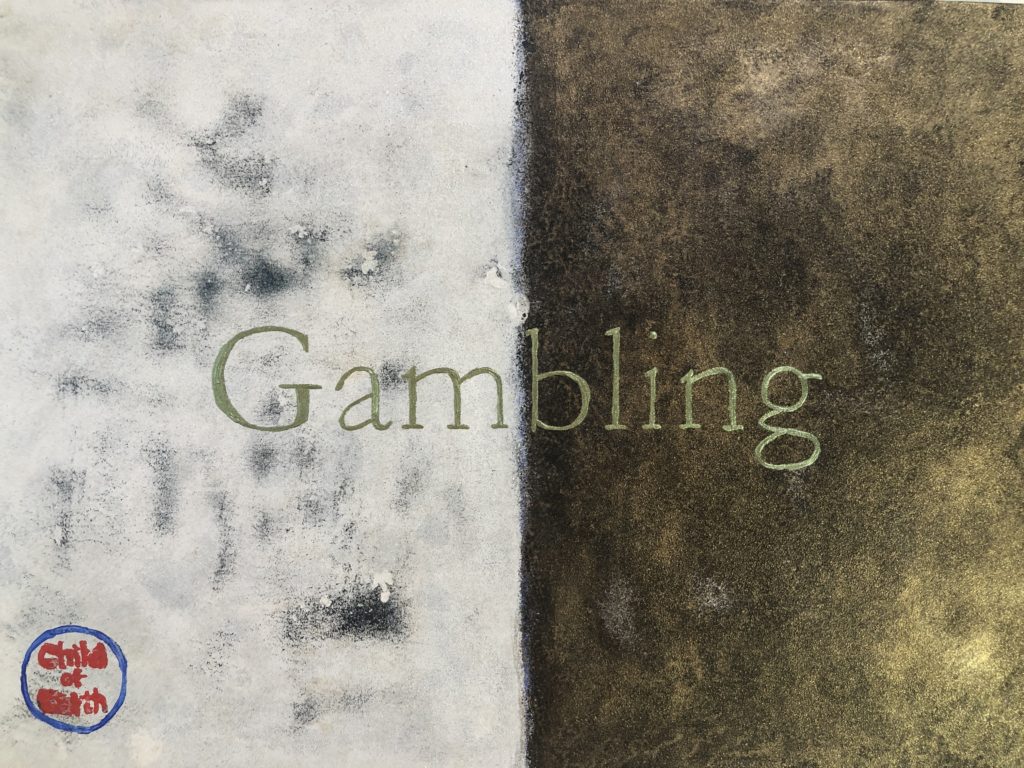
About This Artwork
When I created this work, I did not want to paint gambling as something loud, flashy, or dramatic.
I wanted to show its divided nature.
That is why I separated the surface into two strong spaces, one light and one dark, and placed the word Gambling across the middle.
For me, gambling lives on a border.
On one side, there is hope.
The feeling that life might change.
The feeling that money might come quickly.
The feeling of possibility.
On the other side, there is heaviness.
Loss.
Instability.
And the sense of being pulled somewhere harder to leave.
I did not create this piece to judge people from above.
I wanted to hold both sides in the same image.
Because I think gambling often contains both attraction and danger at once.
It can look bright while carrying something dark underneath.
When I made this painting, I wanted it to become a quiet place for reflection.
Not just about gambling itself, but about what it means to risk something important in order to gain something uncertain.
FAQ About Gambling
Is gambling always bad?
Not necessarily in exactly the same way for every person.
Some people may keep a certain distance from it, while for others it may begin to affect money, time, and relationships much more deeply.
So perhaps the better question is not only whether gambling is “good” or “bad,” but what place it is taking in a person’s life.
Is small gambling always harmless?
Not always.
A small amount of money may still carry a large emotional weight.
And sometimes what matters most is not the amount itself, but how much of a person’s attention, hope, or stress becomes tied to it.
So the impact may depend on more than the size of the bet.
If someone cannot stop, does that only mean weak willpower?
It may be more complicated than that.
Sometimes a person may want to stop and still feel pulled back again and again.
That may be a sign that the issue is deeper than simple self-control.
In that case, harsh self-blame may not be the most helpful place to begin.
Looking honestly at what is happening may be more important.
Conclusion
Gambling is not only about games.
It is about money, desire, freedom, risk, hope, and loss.
That is why it can feel powerful.
And that is also why it can become dangerous.
A person may begin by wanting more money.
But along the way, money may not be the only thing at stake.
Time may be at stake.
Peace may be at stake.
Trust may be at stake.
Life itself may begin to drift toward something smaller and more narrow.
That is why this topic matters.
Not because the answer is always simple,
but because every person must eventually ask:
What am I really trying to gain?
And what am I quietly risking in return?
Sometimes the richest life is not the one that wins quickly.
Sometimes it is the one that keeps what truly matters.
Follow Child of Earth
Instagram
YouTube
Website
Leave a Reply